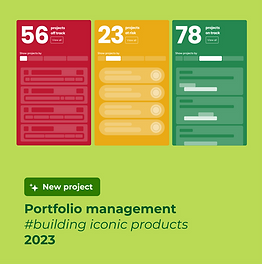
Portfolio management
# Iconic design
My Role: Product design lead • UX/UI Design • UX Research • Product management

Bottom line first
A portfolio management solution that I created A-Z, on the stage of Elevate 2023, the monday.com’s annual online customer conference
Very proud of this achievement, which started from something that I sketched 30 min before the meeting with monday's CEO and ended as a released product.

Foreword
Definitely one of the most challenging, interesting, and inspiring projects I had the privilege to manage, lead, and design in 2023
At monday we are constantly looking for an opportunity to create the most intuitive, bold, delightful design and user experience in order to help our customer achieve their goals.
To continue innovating and create exceptional user experience we developed an internal framework together with the CEO Roy Man and other stakeholders. It's called VVP - Visual, Value, Proposition. This framework was built to help us design and develop products that will make a difference.
As a Product Design Group Lead at this time, I managed the first-ever hackathon following this framework. Later on, I also designed the outcome and managed it all the way until the production. This is how an Iconic Portfolio management solution came to life and met our customers.
Before we dive in, just in case you are not familiar with portfolio management solutions I will shortly explain it. Basically, it helps portfolio managers who manage tens or even hundreds of projects at a time to get a clear overview of all their projects at a glance and understand the status and where the problems are, in one centralized place, so they will be able to act accordingly and make sure they will meet their goals
Goals and opportunities
Business goals:
-
Increase activation vs old portfolio experience from 21 to 30%
-
Increase win rate of portfolio use case against: Asana, and Samrtsheet, from 11.5% to 20%
-
Increase win rate overall in work management
-
Close the feature gap with Asna, Smartsheet
Product design goals
Make portfolio management experience, exceptional. Help users understand the product just by looking at the visual, understand its value, and want to use it.
Product design team goal:
1. Build an iconic product with a Visual Value Proposition
2. Establish a new framework for building iconic products, so other teams in monday
can easily adopt it

The main reason we lose deals in 2022 for New business (large accounts) is because of portfolio and resource management solution
Core Responsibilities:
Product management
I was working directly with Roy Man the CEO and Shierly Baumer the Director of product to define the main problems we wanted to solve, our goals, and the KPIs while taking into account the VVP framework (Visual Value Proposition)
Organizing and leading the first-ever hackathon using the VVP framework at monday.com
I organized a 2-day hackathon outside of the office to launch the VVP work framework.
10 top monday.com product designers including Roy Man the CEO participated in this event.
There were 4 stages in this hackathon: 1. Learn and understand the problem 2. Invent - create an outstanding visual design 3. Validate the design with the reality. 4. Present and get feedback
Product design (Research, UX, UI)
After the hackathon, I took the best options and tested them with real users.
Unfortunately, none of the options got a high score in terms of usability, but it opened our minds and helped me to craft additional concepts afterward.
So I led a new concept from scratch, taking into account the VVP framework for building iconic products. After 2 months of intense work, which included: research, multiple design iterations to explore different concepts, prototyping, user testing, and feedback from multiple stakeholders, we got our first MVP in production.
Taking the part in creating and validating the new framework:
This project was not only important from a strategic perspective but also in terms of setting up the right framework for how we want to build products at monday. I had the privilege to take part in defining the framework and then managing and leading the first-ever hackathon in monday.com following this framework. The framework consists of 5 phases:
Learn
-
Problem scoping - what are we trying to solve
-
Target persona - who will buy? Who will use it?
-
Competitive analysis - what’s good and why?
Invent
-
Invent 3-4 design concepts driven by a unique visual value proposition
-
Make sure they tick all the boxes of uniqueness, covetable, and clear solution
-
Present them billboard first as if you’re running a campaign tomorrow
Compose
-
Break down the concepts into the building blocks and analyze what works and why.
-
Incorporate the real-life needs of the buyer and user persona
-
Validate the design with edge cases
-
Think of the KPIs to test it
-
User testing
Build
-
Build V 0.1 of the product
-
Alpha users
-
The MVP needs to reflect the WOW effect of the original design
-
Production-ready
-
Release plan
Launch
-
Full launch
-
Billboards! - Because we believe we can put our iconic product design on a billboard and it will work
-
Pricing model
-
Website / LPs
-
Launch event
Yael Darel and Roy Mann led the main initiatives around this framework and I had an opportunity to implement it in real life with the first-ever hackathon based on this framework:)
Conducting and leading the hackathon
The hackathon
I organized a 2-day hackathon outside of the office, where 10 talented monday.com designers including Roy Man the CEO, worked together to build the iconic product for portfolio management.
The goal was to achieve an iconic design with a clear VVP-visual value proposition. It means it addresses 3 points:
1. Visually unique
2. Covetable - people want it
3. Understanding the essence and the value of the product from the visual


Presentation and the next steps
5 amazing concepts were created and presented on a company level.

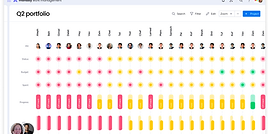
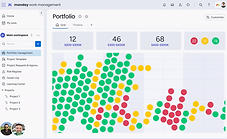


Here are some thumbnails of what our designer did. Credits go to: to Roy and Yael, Shiri and Aviv, Shlomi and Mor, Itamar and Inbal, Eylon and Danielle.
The event was great and all of us enjoyed working together as a design community and crafting the amazing and inspiring design concepts. In terms of setting up the framework, it was a great success as well, but unfortunately, the concepts that were designed didn't meet the reality, and our users' needs. Probably, we went too far for the first time in this hackathon:)
So I needed to change the direction, bearing in mind the framework. So I started working on a new concept to create an iconic product with great VVP. So let's deep dive into it...
Problem statement
User probelem statement
As a portfolio manager, I want to oversee all of the projects at a glance, and quickly identify any problem with the ability to drill down and understand the exact issue, so I will be on top of everything and able to act fast if needed
To write an accurate problem statement I interviewed tens of portfolio, program, and project managers in order to understand their pain points and needs related to the current solution and in general so we can plan our vision accordingly.

Jen Bigos
Planning manager
Cisco

David
Portfolio manager Medical health facility

Daniel Bone
PMO
Mizuho

Petr Fiřt
Corporate Project Manager
Hopi holding

Max Levit
Project/Program manager
Cytel


Yossi Shamir
VP project
Playtech
Jobs to be done
-
I need to oversee tens-hundreds of projects effectively (at a glance)
-
I need to identify problems and bottlenecks among hundreds of projects
-
I need to get actionable data on the portfolio level with the ability to drill down
-
I need to understand the status of the portfolio I manage at a glance
-
I need to report bottom lines to execs & and customers in a clear way
As I mentioned previously, the concepts that we designed in the hackathon were disapproved, after I met them with reality and our users' needs. I conducted several user interviews that helped me understand that we need to change the direction.
So I continued by myself from this point and created a new and very high-level sketch that basically addresses 2 main user main users' needs:
1. Gain control - Understand the status of a portfolio at a glance
2. Identify bottlenecks - Know of issues when they occur
Design process
The first design I made
Actually, it took me 1 hour to create it, right before the meeting with Roy Man about the next steps.
Gain control:
By dividing all of the projects in the portfolio by the RAG status (project management methodology and convention of labeling projects for Red/Off track, Amber/At risk and Green/On track) I created a clear understanding of the portfolio status. In terms of design, bold colors, and large typography with unique data visualization are supposed to address the visual value proposition. From the first glance we understood that there is something we can work on here, so I continued to develop the concept further.


Identify bottlenecks
This is how I planned to address the second point of Identifying bottlenecks and the drill-down


I continued developing the concept
I started working super fast in quick iteration, exploring different directions we can take from this initial starting point. Simultaneously I constantly validated the design with our main persona - Portoflio manager.
First of all, I wanted to understand what will be the first impression and if it is clear what value if any it brings. Secondly, I wanted to make sure the unique data visualization I created, was not only unique but also easy to understand. Therefore I tried to find the right balance between uniqueness and usability.
Actually, from the beginning there was great, positive feedback from portfolio managers I interviewed regarding the value just from looking at it, so we understood we were on the right track here.
In order to move fast I invited Tamir Pomerantz, an amazing freelance designer who helped me to create, multiple options and move this project forward faster.
Here are some directions we crafted and tested with our users
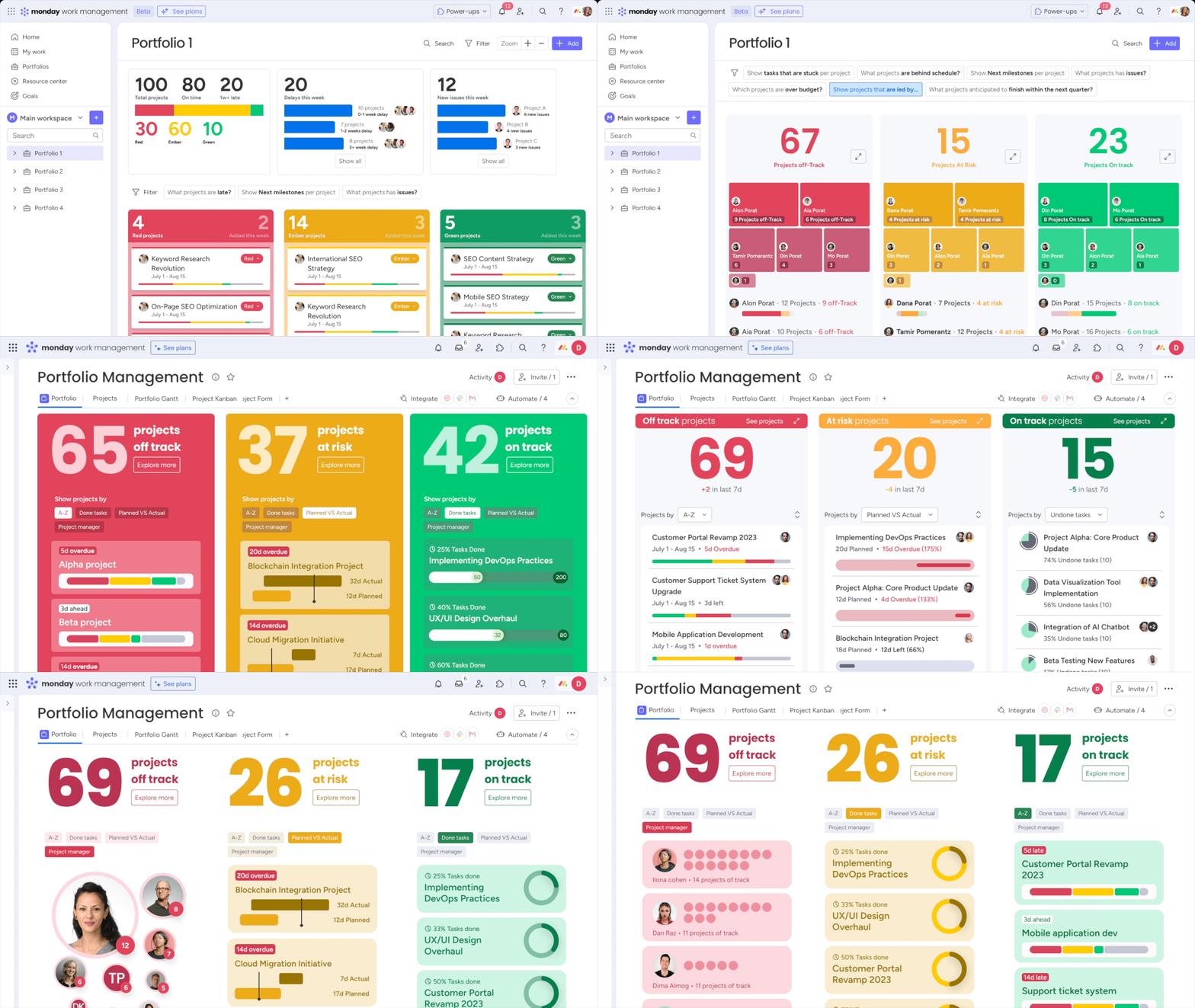
I've tested multiple concepts and explored dozens of design directions. In addition to that, I worked closely with senior leadership (CEOs, Directors), so all of us would be aligned and we could move forward faster.
Validating the design
I constantly tested the design with our target audience to understand the overall impression and to make sure the data visualization we designed was clear to the user yet still "iconic"
We got a very good first impression and feedback from portfolio managers :
Finalising the design and moving to dev
After validating the design I created a vision video to align everyone in the team about the final outcome for this portfolio management MVP
Finally! It was a long, intense, challenging but very satisfying project.
As a Product Design Group Lead usually I do not have many opportunities to craft something by myself and wear the hat of a Product Designer. And I have to say that I missed it a little bit, therefore this project was so exciting and meaningful for me. Making an impact through doing, is very satisfying:) Here it is:


Sense of control and clarity
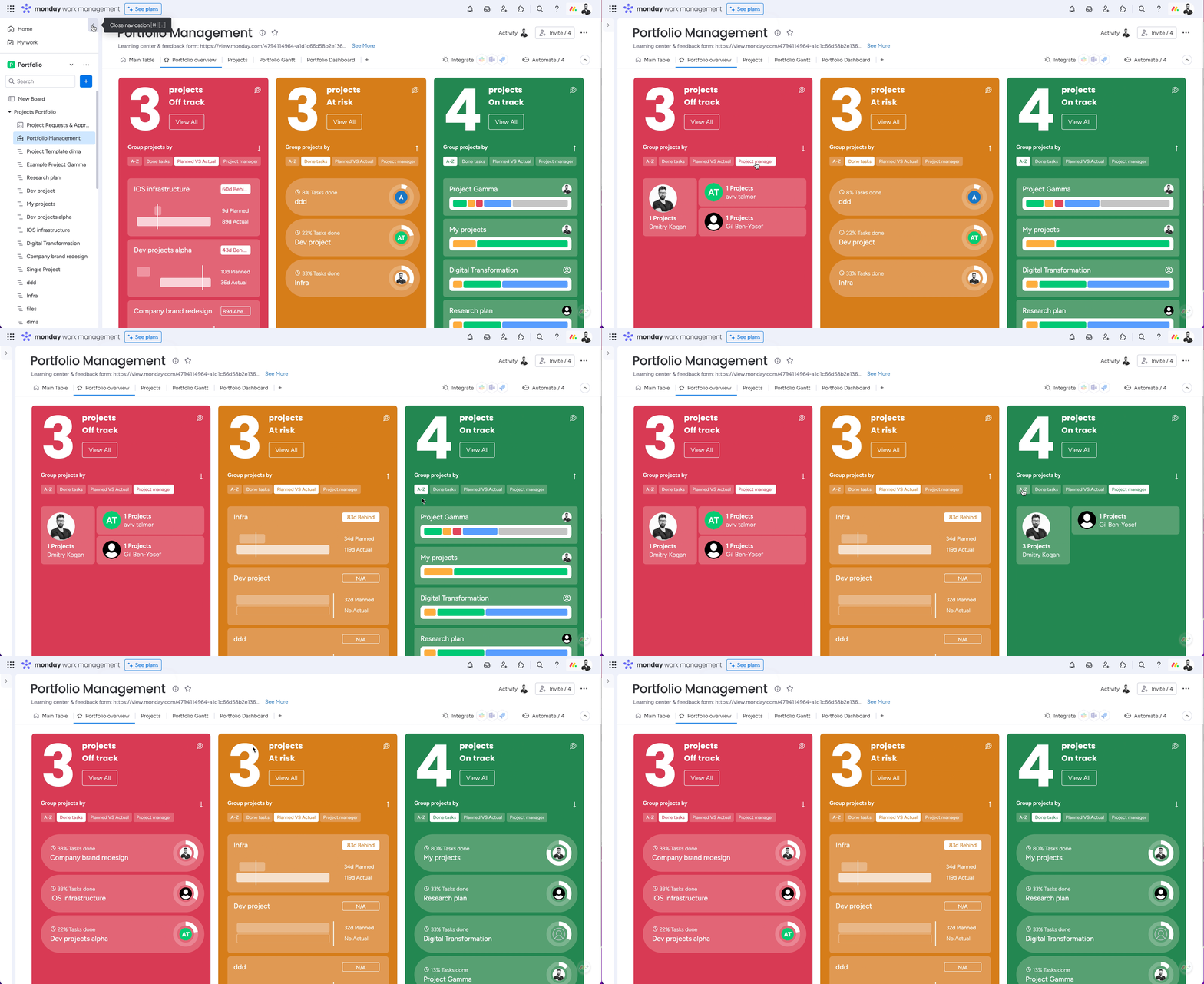
As you can see we clustered all of the projects into 3 different groups based on their status - RAG (Red, Amber, Green), so the portfolio manager will be able to understand the status of all of the projects in the portfolio at a glance. In addition to that, we provided different options for grouping the projects inside each of the RAG states to provide portfolio managers the ability to understand in depth the status of each cluster so they will be able to act accordingly
For example, the portfolio managers can go to a Green bucket and group all the projects by PM, in this way, they will be able to see how many On-track projects are assigned to each of the PMs, and in this way, they can make a decision and reassign PMs to Off track projects.
So, how does it look in production?
We opened it to our Alpha users to monitor the data. In addition to that, we continued user interviews to understand what is still missing and what could be improved
In terms of metrics, we want to understand
-
How many users load the view - retention
-
How many users do an action on the view?
-
What are the changes they do in the view? ( sort, change filter, etc), and to what they change it?
-
What are the work actions done? (click to view all, and open a project)
-
How many click on navigate from overview to the project board?
This is how the very basic MVP looks like in production
It is still missing the micro animations and delight. In addition to that some functionalities like the popover that should open on hover with more information about the projects are missing.
But this is the MVP and it already brings value: Gain control and understand the status of the portfolio at a glance
Porotlfio management launch 2024
In addition to the portfolio iconic view, I've been working on the holistic flow, which includes: project creation, project management, project overview etc. In March 2024 we launched our new portfolio management experience that I had the privilege to lead in terms of product, design and user expereince
Next steps in terms of design
So we just launched the first MVP of the portfolio management iconic design.
First of all, we will monitor the quant data and continue interviewing our users in order to better understand what is missing, and what can be improved.
In addition to that, we will start working on a new iconic design for portfolio management to create another version for it. I think that as a company we are constantly looking for a new fresh design that will bring added value to our customers in the most delightful and intuitive way. Actually we are a product and design-driven company, therefore design is one of the most important epics when we build products
Project learnings & takeaways
Working with CEO
Working directly with the CEOs is never easy, but it is always valuable and inspiring. It was great to see how visionary they are and how I as a designer can empathize with their vision and together we can design better products, with better user experience and value to our users. I really believe that the VVP framework can help us build iconic products, better compete on the market, and make a desirable product that people will love to use.
Adapting a new framework.
When doing something the first time, prepare yourself to fail but don't think about failure, just enjoy the process of doing something for the first time, definitely great things will come out of it
Creating multiple options, testing fast, reiterating, and testing again
The only way that helped me to move forward was to test everything fast. Yes in this case the speed of testing had a large impact on this project. I succeeded in creating multiple solutions (prototypes) quickly and then I was able to test them with users within 1-2 days share the results with everyone and move to the next iteration of the design.
I used usertesting.com live sessions and also conducted unmoderated usability testing. Then I shared short videos with the main conclusions and summaries to keep everyone in the loop and moved forward to refining the solutions